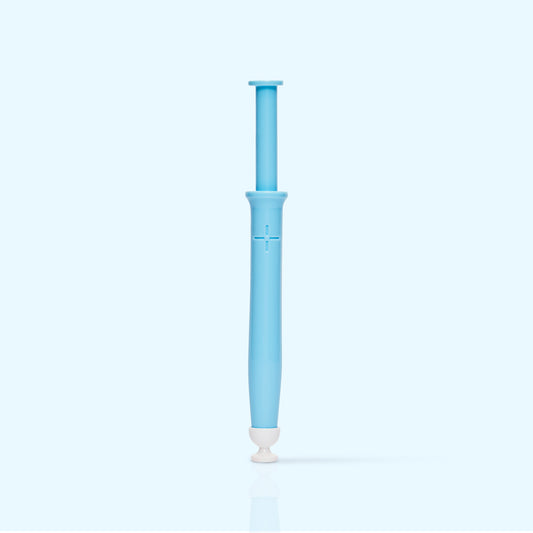
Why Balance Shifts After Sex, and How to Support It
When most people talk about sex, the focus is on what leads up to it and what happens during it: foreplay, pleasure, connection, performance. What doesn't get nearly enough attention is what happens after. Vaginal aftercare often gets overlooked, yet it can make the difference between feeling comfortable the next day and dealing with irritation or odor you weren't expecting.
The good news is that this is one of the more predictable disruptions your body deals with, which makes it one of the easiest to plan around. A vaginal probiotic like our Intimate Care Gel is built for exactly these moments. But it's worth understanding what's actually happening first, because the timing matters more than the product does.
What Actually Changes
Sex temporarily shifts your vaginal environment, and the main reason is chemistry. Your vagina sits in a slightly acidic range, around 3.8 to 4.5. Semen is alkaline, closer to 7.2 to 7.8. When the two meet, your pH rises, and it can take hours for your body to bring it back down.
Other things add to it. Friction, lubricant ingredients, and where you are in your cycle all play a part. Your body corrects this on its own, but the correction takes time, and while pH sits higher than usual, the Lactobacillus that normally dominates is less able to keep other organisms in check.
Why You Notice It Later
This is why nothing feels wrong in the moment. The shift is gradual, so what you register is the aftermath: itching, dryness, irritation, or an odor that wasn't there yesterday.
A lot of women file this under "that's just how it is." It isn't. It's a signal that your flora is working through a disruption, and it's one of the more predictable moments in the month to give it support.
Aftercare Isn't an Extra Step
You wash your face after a workout. You moisturize after time in the sun. Neither of those is indulgent. They're just what you do after something that changes your skin.
Intimate aftercare works the same way. It isn't a treatment, and it isn't about fixing a problem. It's maintenance timed to a moment when your body is already doing extra work.
Why a Gel Fits This Moment
Oral probiotics have to travel from your gut before any of them reach the vaginal environment, and most never arrive. That timeline doesn't match what you need here. You're not looking for something to build up over weeks. You're looking for support in a specific window.
A vaginal gel is applied directly, so Lactobacillus goes exactly where the disruption happened. That's what makes it a practical fit for aftercare, and why our Intimate Care Gel comes in single-dose packaging: one application, nothing to measure, nothing to store.
Before, Not Only After
Here's the part most people skip. Applying a gel beforehand works too.
If aftercare is about helping your body recover, pre-care is about it starting from a stronger place: hydrated, acidic, and well populated with the bacteria you want. Same logic as sunscreen. You don't wait for the burn.
One Thing Worth Saying Plainly
If odor, itching, or discharge keeps returning after sex, see a doctor. Recurring symptoms deserve a diagnosis, and a probiotic gel supports a healthy environment rather than replacing one.
Balance isn't something you either have or don't. It shifts, it recovers, and it responds to what you do around the moments that move it most. Knowing when those moments are is most of the work.
References
- Amabebe E, Anumba DOC. The vaginal microenvironment: the physiologic role of lactobacilli. Frontiers in Medicine. 2018;5:181. https://www.frontiersin.org/journals/medicine/articles/10.3389/fmed.2018.00181/full
- Dhumal SS, Naik P, Dakshinamurthy S, Sullia K. Semen pH and its correlation with motility and count: a study in subfertile men. JBRA Assisted Reproduction. 2021;25(2):172-175. https://pmc.ncbi.nlm.nih.gov/articles/PMC8083857/
- Temporal dynamics of the human vaginal microbiota. Science Translational Medicine. https://www.science.org/doi/10.1126/scitranslmed.3003605
- Temporal variability of human vaginal bacteria and relationship with bacterial vaginosis. PLOS One. 2010. https://journals.plos.org/plosone/article?id=10.1371%2Fjournal.pone.0010197
- Vaginal colonization by orally administered Lactobacillus rhamnosus GG. 2003. https://pubmed.ncbi.nlm.nih.gov/14650098/