Feeling Looser After Birth?
Search this and you will find the same answer nearly everywhere: your body returns to its usual size and shape within about two to six weeks. Most sources agree, and they are not wrong.
They are just answering a narrower question than the one you are asking. Here is what each stage actually covers.
The First Two Weeks: The Acute Part
This stage is dominated by things that are visibly resolving. Bleeding, called lochia, is heaviest immediately after delivery and gradually lightens in both color and volume. Swelling and soreness are at their peak and begin easing. If you tore, and around 85% of women who deliver vaginally experience some degree of perineal trauma, closer to 90% with a first baby, this is when stitches begin dissolving.
Almost nothing about how things feel long term is settled here. Your tissue is still swollen, which means any impression you form in these weeks is not a reliable read on where you will land.
Weeks Two to Six: Retraction
This is the window the standard answer refers to. Tissue that stretched during delivery retracts substantially toward its former dimensions. Swelling resolves. Tears and incisions close.
By the end of it, most women are physically healed in the sense their provider is assessing.
The Six-Week Appointment: What It Checks
Worth being precise about, because it is where expectations and reality separate.
That appointment confirms your tissue has closed, your uterus has returned to size, and you are medically safe to resume normal activity including sex and exercise.
It is a clearance, not a verdict on how things feel. Your provider is checking that nothing is wrong. They are not measuring firmness, sensation, or whether things feel the way they did before, because those are not what the appointment is for.
Leaving that appointment cleared and still noticing a difference is not a contradiction. It means you are past the acute stage and into the slower one.
Weeks Six to Twelve: The Hormonal Layer
Here is the part most timelines skip. Estrogen drops sharply after delivery and stays low throughout breastfeeding. Low estrogen commonly produces dryness, thinner-feeling tissue, and reduced suppleness.
This is temporary, and it is not something you can train or accelerate. It resolves as your cycle returns, which for many breastfeeding women means months rather than weeks. If things feel dry or fragile at this stage, hormones are the likeliest explanation, and the answer is largely time.
Beyond Three Months: What Doesn't Run on a Schedule
Past this point, waiting stops being the strategy. What you notice now is unlikely to change further on its own, and that is the moment to shift from recovering to maintaining.
It is also worth knowing that effort alone does not cover everything here. Exercise builds strength. It has no effect on how supple or firm the surrounding tissue feels, which is a separate property with separate inputs.
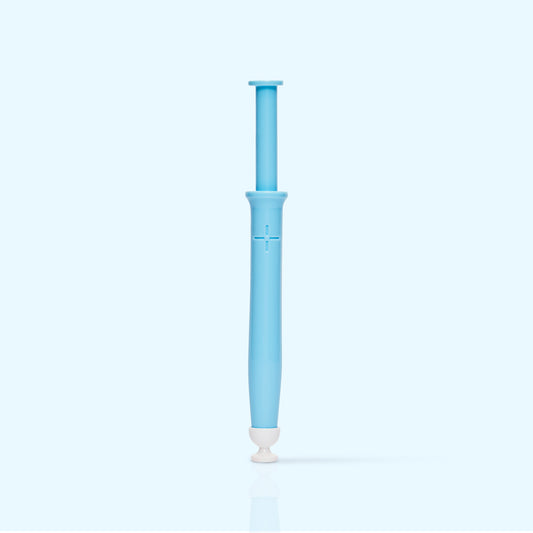
Our PDRN Intimate Recovery Gel is built for that second thing. The Vegan Phyto-PDRN works on how the tissue itself feels: suppleness, comfort, and the kind of firmness that no amount of waiting or exercising will bring back. The change is gradual rather than immediate, which is the honest expectation to set at this stage. You are not undoing anything. You are giving the tissue something to work with.
References
- Healing-assessment tools for perineal and cesarean section wounds in postpartum women: a scoping review. https://www.ncbi.nlm.nih.gov/pmc/articles/PMC12746225/
- ACOG Committee Opinion No. 736: Optimizing postpartum care. American College of Obstetricians and Gynecologists. 2018. https://www.acog.org/clinical/clinical-guidance/committee-opinion/articles/2018/05/optimizing-postpartum-care
- Postpartum and lactation-related genitourinary symptoms: a systematic review and meta-analysis. Obstetrics & Gynecology. https://journals.lww.com/greenjournal/abstract/10.1097/aog.0000000000005940~postpartum-and-lactation-related-genitourinary-symptoms-a
- Genitourinary syndrome of lactation: a new perspective on postpartum and lactation-related genitourinary symptoms. The Journal of Sexual Medicine. 2024. https://pubmed.ncbi.nlm.nih.gov/38757214/
- The use of topical vaginal estrogens in postpartum women: a systematic review. https://pmc.ncbi.nlm.nih.gov/articles/PMC13308989/